Quick answer: what is the best AI image generator?
For most people, ChatGPT is the best AI image generator because it combines strong output quality with the simplest editing loop: describe the image, inspect it, then ask for precise changes in ordinary language. It is not the winner for every job. Midjourney remains stronger for art-directed visual exploration, Recraft is better for structured design assets, Adobe Firefly is the safer operational fit inside Creative Cloud, and Ideogram deserves a place when typography is central.
That conditional answer matters. Image quality among leading systems is now close enough that workflow, editability, text rendering, licensing, privacy and price can matter more than a single beauty contest.
HOW WE TEST: The AI Leaderboard has tested more than 50 AI image tools. We use identical prompts, rerolls and controlled edits, then compare prompt adherence, text, consistency, realism and workflow—not vendor showcase images.
Rank | Tool | Best for | Why it ranks here | Main caveat |
|---|---|---|---|---|
1 | ChatGPT | Best overall | Excellent general quality, conversational editing and broad availability | Usage limits and policies vary by plan |
2 | Gemini | Fast iteration and Google users | Strong generation and editing in a familiar assistant workflow | Product limits vary by account and region |
3 | Midjourney | Art direction and visual style | Distinctive aesthetics and strong creative exploration | Subscription required; less convenient for structured business workflows |
4 | Recraft | Brand graphics and design assets | Design-oriented controls, structured outputs and practical production tools | Less compelling when the goal is purely cinematic art |
5 | Adobe Firefly | Creative Cloud and commercial workflows | Photoshop integration, licensed training approach and provenance features | Top raw generations are not always the category leader |
6 | Ideogram | Text-heavy graphics | Consistently emphasized by hands-on reviewers for typography | A specialist advantage does not make it best at every visual style |
How we decided what “best” means
How we rigorously test AI image generators
The AI Leaderboard team has tested more than 50 AI image tools. We use broad screening to identify credible products, then repeatedly test the strongest candidates across different model versions and workflows. A tool does not rank because of one attractive result: we look for quality, repeatability, control and usefulness after several rounds of prompting and editing.
Every shortlisted tool receives the same core prompts wherever the product supports them. We compare first-pass results, rerolls and follow-up edits rather than selecting only the best image from a vendor gallery. We also record the tool, model or product version, test date, plan and whether an example is a first result or a reroll. Because these systems change quickly, we retest major releases and revise the ranking when the evidence changes.
Test | What we ask the tool to do | What counts as a strong result |
|---|---|---|
Complex prompt adherence | Follow exact counts, objects, colors and spatial relationships | All requested details appear without extra subjects or contradictions |
Text rendering | Reproduce exact headlines and smaller copy inside a designed image | Correct spelling, readable type and a usable hierarchy |
Editing control | Change only named elements while preserving the scene | Requested edits appear without unwanted changes elsewhere |
Character consistency | Show one person across poses, views and expressions | Identity, clothing and distinguishing features remain stable |
Commercial design | Create product, advertising and brand-style assets | Clean composition, credible materials and room for real layout work |
Photorealism and anatomy | Render hands, tools, reflections, lighting and physical interactions | Believable geometry and materials at close inspection |
Example: the midnight bakery prompt
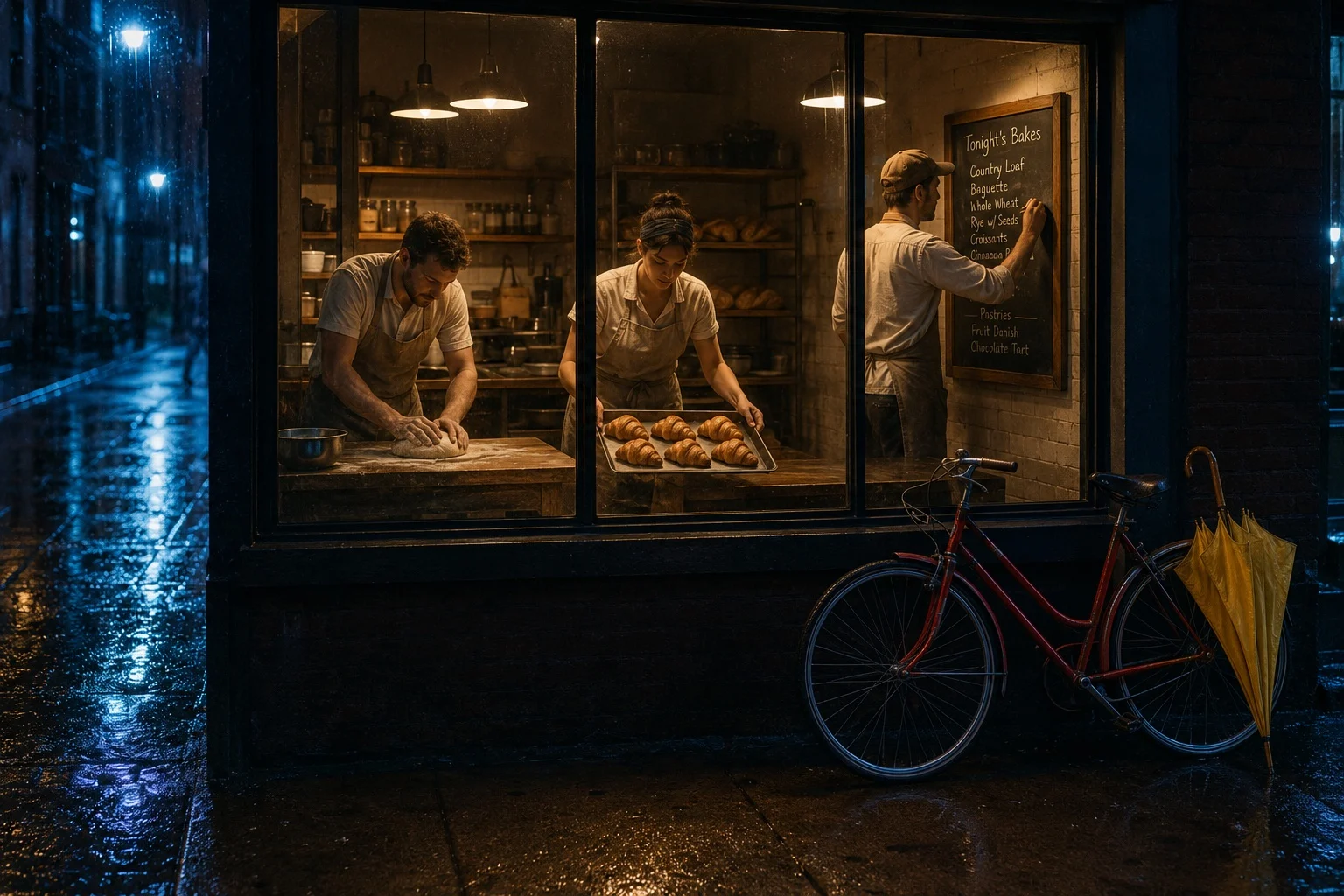
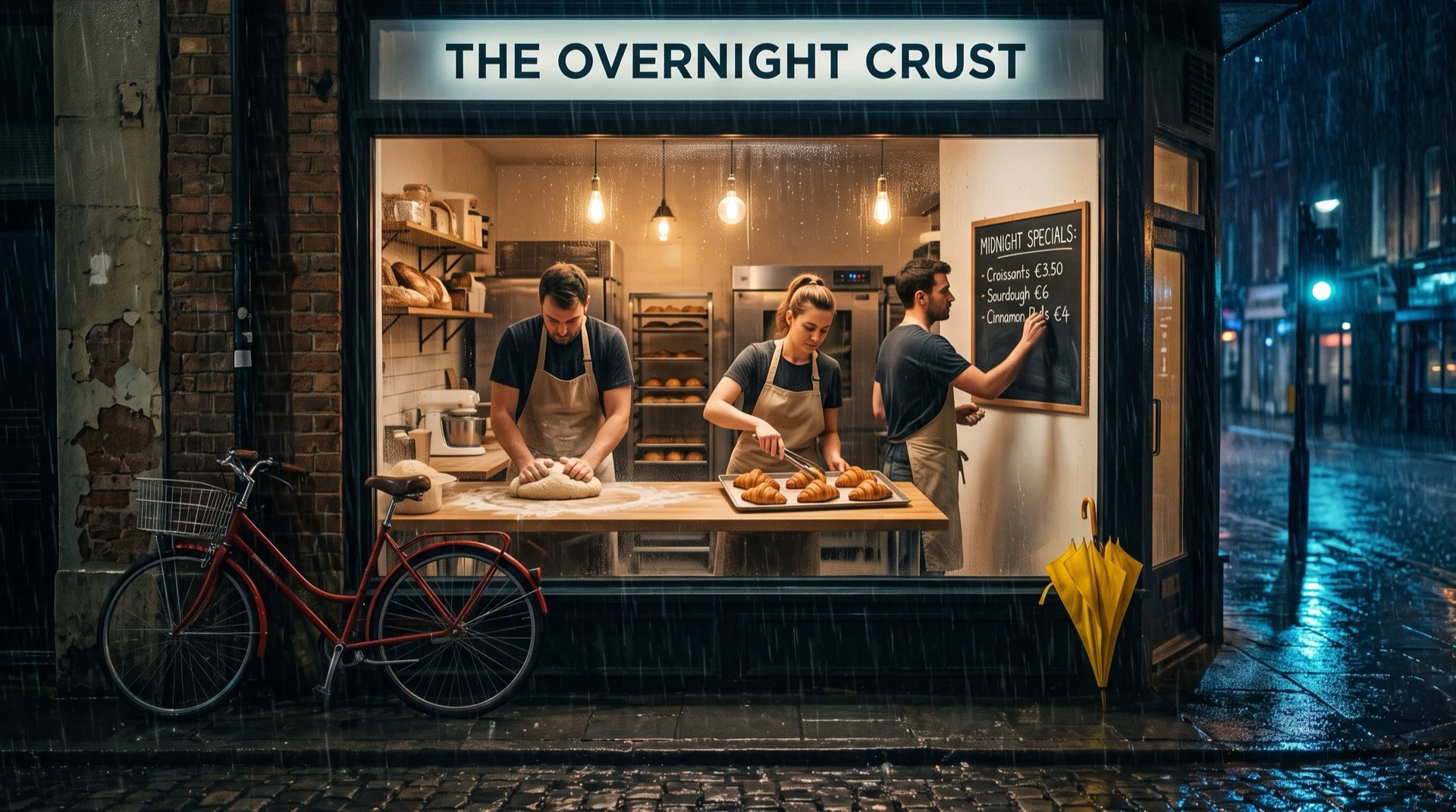
The ChatGPT and Gemini images shown below use the same difficult prompt: “A photorealistic editorial photograph of a small midnight bakery during a rainstorm. Through the window, exactly three bakers are visible: one kneading dough, one placing six croissants on a tray, and one writing the day’s menu on a chalkboard. A red bicycle is parked outside beside a yellow umbrella. Warm interior lighting, cool blue street reflections, 35mm photography, landscape composition, no additional people.”
This prompt tests more than visual appeal. We check whether the image contains exactly three bakers, assigns the correct task to each person, shows six croissants, preserves the red bicycle and yellow umbrella, and separates the warm bakery from the cool rainy street. Both examples satisfy most of the requested structure, while also revealing differences in framing, realism, text behavior and visual style. Those differences are why identical prompts and visible outputs are more informative than promotional samples.
We began with the exact query “best AI image generator,” recorded the candidates that repeatedly surfaced, then followed the disagreements. Search results agreed that ChatGPT belongs near the top, but split on Gemini, Midjourney, Recraft, Firefly and Ideogram because each publication weighted a different job.
The strongest comparative signal available at scale is blind human preference voting. The Arena text-to-image leaderboard provides a common voting environment, while Artificial Analysis runs a separate image arena. These are more useful than isolated vendor examples, but neither measures every production requirement.
We also relied on a current Zapier hands-on comparison because its reviewer tested the same prompts across tools and evaluated the applications, not only the underlying models. Its shortlist names ChatGPT for overall use, Midjourney for artistic results, Ideogram for text, Firefly for photo workflows and Recraft for graphic design.
Criterion | What we looked for | Why it matters |
|---|---|---|
Prompt adherence | Whether all requested subjects, relationships and constraints appear | A beautiful image of the wrong scene is still a failed result |
Editing | Inpainting, reference images, conversational revisions and consistency | Production work usually requires several controlled iterations |
Text rendering | Spelling, layout and repeatability across reruns | Marketing graphics fail quickly when typography is wrong |
Aesthetic range | Photorealism, illustration, design and stylization | One default visual taste does not suit every brief |
Workflow | Web app, assistant, API and creative-software integration | Friction and handoffs affect the real cost of an image |
Rights and provenance | Training disclosures, commercial terms and credentials | Professional users need more than attractive pixels |
Price and limits | Free access, subscriptions, credits and API costs | The cheapest tool depends on volume and reroll rate |
Best AI image generators ranked
1. ChatGPT: best overall
ChatGPT wins the broad recommendation because it makes image generation feel like editing with a patient creative partner. You can begin with a loose concept, ask for a different composition, preserve selected elements and refine wording without learning a separate control language.
Zapier names ChatGPT its best overall option after testing leading tools with shared prompts. Blind-vote leaderboards also place OpenAI image systems in the leadership group. That evidence supports a strong general verdict, but it does not prove that ChatGPT wins every prompt category or every professional workflow. See our ChatGPT plan comparison before paying only for higher image limits.
- Strengths: conversational editing, strong prompt following, capable text rendering and easy access.
- Weaknesses: plan limits can interrupt iteration, and precise design-system work may still need a specialist editor.
- Best fit: marketers, educators, general creators and anyone who values a fast brief-to-revision loop.
2. Gemini: best for rapid iteration in Google’s ecosystem
Gemini is the strongest alternative for users who want capable generation and editing inside a general assistant. Retrieval results repeatedly highlighted its speed, free availability and ability to work from reference images. It is particularly convenient when the surrounding project already lives in Google tools.
The caveat is product complexity. Google changes model access, quotas and plan names quickly, so a recommendation based on one temporary allowance can age badly. Judge the account you can actually use, not a screenshot from someone else’s plan.
3. Midjourney: best for art direction
Midjourney remains the better choice when the desired outcome is a strong visual point of view rather than a literal business graphic. Its value is taste: concept art, mood, fashion, editorial illustration and cinematic exploration often look finished with less prompting.
That strength is also the limitation. A persuasive default aesthetic can drift from a tightly specified brief, and a subscription-first workflow is harder to justify for occasional users. Choose it because you want its creative behavior, not because it appears in every historical best-of list.
4. Recraft: best for brand graphics and design assets
Recraft is built around design rather than only image synthesis. Its official pricing page separates free and paid usage, while hands-on comparisons emphasize graphic-design workflows and structured assets. That makes it a better fit for icons, social graphics, brand systems and repeatable visual production than for one-off cinematic scenes.
Its ranking is use-case driven. Human-preference arenas can tell us whether voters like an image, but they do not fully measure editable output, brand consistency or the time saved in a design workflow.
5. Adobe Firefly: best for Creative Cloud and commercial operations
Adobe says in its Firefly FAQ that current Firefly models were trained on licensed content such as Adobe Stock and public-domain content, and that Creative Cloud subscriber content is not used for training. It also allows commercial use of outputs from non-beta features and applies Content Credentials to certain exports.
Those assurances do not remove every legal question, but they are unusually concrete. For more on the difference between provenance and proof of authorship, read our AI watermarking guide. Firefly is the practical winner when reviewability, Photoshop integration and content provenance matter more than topping a beauty leaderboard.
6. Ideogram: best for typography
Ideogram remains a specialist recommendation for posters, signs, covers and social graphics where spelling and layout are central. Multiple hands-on comparisons independently surface it for accurate text. That agreement is useful, but most reviews do not publish a large blinded typography dataset, so the claim should be read as repeated reviewer evidence rather than a universal benchmark result.
Comparison grid: choose by the job
Job | Best starting tool | Why | Alternative |
|---|---|---|---|
General creation and editing | ChatGPT | Strong quality with the easiest revision conversation | Gemini |
Art direction and mood | Midjourney | Distinctive aesthetics and exploratory range | ChatGPT |
Brand graphics and reusable assets | Recraft | Design-oriented controls and structured workflow | Adobe Firefly |
Photoshop-based production | Adobe Firefly | Native Creative Cloud workflow and provenance features | ChatGPT |
Text inside images | Ideogram | Repeatedly strong in hands-on typography tests | ChatGPT |
Occasional free use | Gemini or ChatGPT | Low-friction free access when limits permit | Recraft free tier |
Why image-generator rankings disagree
Different rankings are often answering different questions. Blind preference rewards the image people like at first glance. A design review may reward editable vectors and typography. A marketing team may prioritize legal review, batch throughput and predictable revisions. A photographer may care most about generative fill inside an existing file.
Version timing also matters. Image systems change quickly, and a review can be accurate when published yet stale a few months later. We therefore avoid treating one model version or one Elo score as a permanent truth.
Benchmark limitations
Blind-vote arenas are valuable because models face prompts in a common environment and voters do not need to know the provider. They still have limits: the prompt distribution reflects arena users, votes emphasize visible preference, interfaces may apply different defaults, and scores can move when new models or votes arrive.
Hands-on reviews add workflow context but have smaller samples and unavoidable reviewer taste. Vendor galleries show capability under selected conditions, not typical failure rates. The honest conclusion is triangulation: use arenas for broad quality, repeated hands-on findings for specialist strengths and primary documentation for terms and workflow facts.
Frequently asked questions
What is the best free AI image generator?
Start with the free access available in ChatGPT or Gemini, then compare the limits against Recraft or Adobe Firefly. Free quotas change often, so the practical winner is the tool that gives you enough iterations for the current project.
Which AI image generator is best for text?
Ideogram is the strongest specialist starting point for text-heavy graphics, with ChatGPT as the better all-purpose alternative. Always proofread every generated word and expect to rerun complex layouts.
Which is best for commercial use?
Adobe Firefly is the clearest operational choice for teams already using Creative Cloud because Adobe publishes specific training-data and commercial-use guidance. Commercial use still requires checking the current terms, trademarks, likeness rights and the intended jurisdiction.
Can AI image generators keep a character consistent?
Leading tools can use references and iterative editing to improve consistency, but none should be assumed perfect across a long campaign. Test multiple poses, lighting conditions and crops before committing to a tool.
Final verdict
ChatGPT is the best AI image generator for most users because it combines strong images with the most approachable editing workflow. Choose Midjourney for art direction, Recraft for structured design, Firefly for Creative Cloud and commercial operations, Ideogram for typography, and Gemini for fast assistant-based iteration. The best tool is the one that minimizes failed revisions for your actual brief, not the one with the prettiest demo gallery.
Research and verification notes
- Initial retrieval surfaced ChatGPT, Gemini, Midjourney, Ideogram, Firefly, Recraft, FLUX, Leonardo and several newer specialist systems.
- Final rankings relied on blind-vote leaderboards for broad quality, a current same-prompt hands-on review for workflow judgments and primary vendor documentation for product claims.
- Exact model-version scores were not frozen into the ranking because live arenas and products change quickly.
- No vendor accuracy or quality claim was treated as independent evidence.